KAUFMAN FIELD GUIDES
  • Home
  • The KFG Series
    • About Kaufman Field Guides
    • Birds
    • Butterflies
    • Mammals
    • Insects
    • Advanced Birding
    • Nature of New England
    • Nature of the Midwest
    • Guía de campo Kaufman a las aves de Norteamérica
    • Contact Kaufman Field Guides
  • The Illustrations
  • About Kenn
  • Kenn on The Issues

Eponymous Bird Names and the History of Ornithology

12/3/2023

38 Comments

 
​In early November 2023, the American Ornithological Society, which has maintained the official names of North American birds since the 1880s, announced a major change. All birds with directly eponymous English names—that is, species named for a person, like Swainson’s Hawk or Steller’s Jay—will be renamed, through a gradual process, to make their names more descriptive. 

​Like any change, this has sparked controversy. The majority of serious birders and ornithologists seem to be in favor of the change, but a significant and vocal minority opposes it. One reason they give for maintaining eponymous names is the suggestion that removing them amounts to “erasing history” or “canceling history.” 

Picture
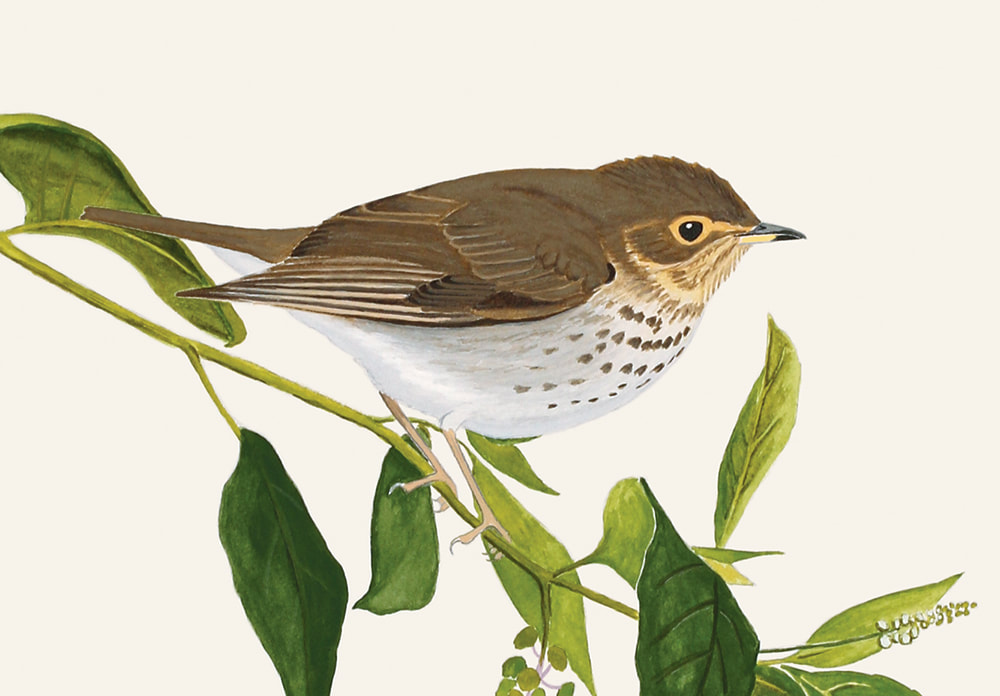
​The bird currently known as Swainson's Thrush.  
​Watercolor by Kenn Kaufman.​

​British naturalist William Swainson didn't discover this species, or describe it (except possibly by accident, when he thought he was referring to another bird). His brief writings about North American thrushes only added to the confusion about this group of birds.  
That claim caught my attention, because over the last five years I’ve spent a huge amount of time researching the history of bird study for a writing project. At one level I am thrilled to see all these people expressing an interest in history, some probably for the very first time. And if I thought history was being “erased,” I would be the first to protest. But I think that concern is misplaced, for two reasons: 1. It’s relatively rare for eponymous bird names to lead anyone to learn about history; and 2. Those eponymous names do a very poor job of reflecting actual history. 

1. Do eponymous names naturally lead to curiosity about the persons so recognized? I don’t think so. If we were to poll the ornithologists and serious birders of North America, I suspect that not one in a thousand would know who Botteri was (of Botteri’s Sparrow) or who Williamson was (of Williamson’s Sapsucker). Most wouldn’t know that Clark’s Grebe and Clark’s Nutcracker were named for different Clarks, or that Ross’s Goose and Ross’s Gull were named for different Rosses. None of the listers dashing to Florida to get their La Sagra’s Flycatcher for the year would be able to tell you who La Sagra was. All these names have been there in the field guides and other books for many years, but hardly anyone has been inspired to say, “Gee, who was Heermann? Who was Hutton?” If these eponyms are supposed to serve as an invitation to study history, the invitation is mostly being declined. 

2. Do eponymous English bird names accurately reflect history? No. Study a list of birds with English names honoring individual humans. Based on these names, you’d have to conclude that the most important figures in U.S. bird study were Alexander Wilson and John Cassin. Each is honored in the English names of five species (Wilson’s Warbler, Plover, Phalarope, Storm-Petrel, and Snipe; and Cassin’s Sparrow, Kingbird, Finch, Auklet, and Vireo). So, is it fair to say that these two men were the towering giants of U.S. ornithology? No. 

Wilson was definitely a leading figure, launching his ambitious 9-volume American Ornithology in a burst of productive energy between 1808 and his death in 1813. He wasn’t much into the idea of naming birds for people, but after he worked himself to death at the age of only 47, friends and admirers named several birds after him. 

And John Cassin? Based at the Academy of Natural Sciences of Philadelphia, he was one of several competent ornithologists in the mid-1800s. He did some good work—but no more than George N. Lawrence (honored in the names of one species and one hybrid), Spencer Baird (with two species), or Robert Ridgway (one, plus one hawk in the Caribbean). Why did Cassin wind up with more eponyms? It was just a fluke, reflecting how trivial and random the application of such names could be. 

In the early decades of scientific naming under the Linnaean system, few eponyms were used. The 10th edition of Linnaeus’s Systema Naturae in 1758, considered the starting point for zoological nomenclature, had no English names, of course, but the Latin names rarely referenced individual persons. The name of the Red-breasted Parakeet (Psittacus alexandri, now Psittacula alexandri) honored Alexander the Great, and some names were based on characters from mythology, but in general Linnaeus was not naming birds after his pals or patrons. That kind of thing would come later.  

From the 1820s to the early 1840s in North America, John James Audubon was handing out eponyms like candy. At first he was trying to court favor with British naturalists (like Bewick, Henslow, or Swainson) or with wealthy individuals who might support his work. Later he used names to honor various friends and colleagues (like Harris, Sprague, or Bell). Our list would be cluttered with even more Audubon-coined eponyms except that some of his supposed new birds (like Rathbone’s Warbler, Selby’s Flycatcher, Vigors’s Warbler, Shattuck’s Bunting, and others) turned out to be either not new, or not valid species. 

Another burst of eponymous naming from the 1850s to the 1870s involved more players. As bird specimens from the West and Southwest were sent east, biologists at major museums described new species and often named them for their peers. John Cassin was especially generous with such names. Perhaps inspired by his example, others named birds for him, too, and Cassin wound up recognized in more eponyms than any of them. It was a fluke, a reflection of timing and pure chance, not a reflection of Cassin’s stature in the field. 

In contrast to John Cassin’s five eponymous birds, no bird species in the U.S. bear English names honoring any of the following, all of whom made major contributions to bird study or bird conservation: Joel A. Allen, Florence Merriam Bailey, William Bartram, Charles Batchelder, William Brewster, Mark Catesby, Frank Chapman, Elliott Coues, Albert K. Fisher, Minna Hall, Harriet Hemenway, Henry Henshaw, Charles Maynard, Edgar Mearns, C. Hart Merriam, Margaret Morse Nice, George Ord, Charles Willson Peale, Titian Peale, or Louis Pierre Vieillot. Many others could be added to this list. Were these individuals less worthy than those who wound up memorialized in bird names? No. Grace’s Warbler was named for Elliott Coues’s little sister, who never did anything for birds aside from being nice to her brother, but no bird bears an English name honoring Florence Merriam Bailey, who produced major ornithological works as well as writing the first real field guide. Scott’s Oriole was named for a military officer with zero interest in nature, but no bird has an English name honoring William Bartram, America’s top ornithologist of the 1790s and later a mentor to Alexander Wilson. Rivoli’s Hummingbird and Anna’s Hummingbird reference minor European nobles, but no English bird name honors Joel Allen, a founder and first president of the American Ornithologists’ Union. (Allen’s Hummingbird was named for a different guy.) 

No, there was no order or reason to the way in which honorific names were applied. It was uneven, haphazard, sometimes almost silly. If eponymous bird names were really so all-fired important for marking history, wouldn’t fans of such names be demanding more of them? Like, change Orchard Oriole to Catesby’s Oriole, Ring-billed Gull to Ord’s Gull, Snowy Egret to Hemenway’s Egret, Song Sparrow to Nice’s Sparrow, Black-throated Green Warbler to MacArthur’s Warbler. With a little effort, we could pull all the attention away from living birds and focus entirely on dead humans. Fortunately, no one seems to be advocating such a shift, but it would be a logical extension of the urge to hold on to existing eponyms. 

Is the history of ornithology worth knowing? Absolutely! It’s highly important, and intriguing, too. If you delve into it, you learn all kinds of fascinating things. For example, the winter plumage and breeding plumage of the Sanderling were regarded as separate species for half a century, and considered to be plovers, not sandpipers. Early naturalists argued about whether the American Redstart was a warbler or a flycatcher—but both views were wrong, because they were talking about European warblers and European flycatchers, and the American warblers hadn’t yet been defined as a separate group. The Caspian Tern—big, noisy, and conspicuous—wasn’t recognized as occurring in North America until about 1850, because everyone had confused it with the Royal Tern. Insights like these await anyone who decides to learn about the history of our favorite science, and such learning is easier if you avoid the needless distraction of eponymous bird names. 


​Illustration at top of column: The bird currently known as Swainson's Thrush. ​Watercolor by Kenn Kaufman.​
38 Comments
Dave Eshbaugh
12/3/2023 03:17:03 pm

Kenn Kaufman provides a well-reasoned and compelling case for changing from eponymous bird names.

Reply
David Benson
12/3/2023 03:33:51 pm

I wholeheartedly support this. I would also like to see birds named after places renamed, if they give a false impression about where you can find the bird most of the time. For instance rename Tennessee Warbler, which does not breed or winter there but was probably found during migration to be in Tennessee. Habitat names would be better than specific places in my opinion. Since we are going to spend time renaming and relearning the birds, let’s give them all an overhaul if needed.

Reply
David Lindo link
12/3/2023 05:02:00 pm

I have great respect for you and I think that your arguments are measured and reasoned. However, despite this I still have a sense that history is being erased.

However, my biggest problem with this whole thing is the international aspect. As a British birder I can't see birders in the UK and perhaps in Europe adopting the new name changes especially if the new names are not deemed as credible.

I think that if you are going to change the names of the North America birds then you should go the whole hog and change the names of all the birds in the world that are named after people. There needs to be uniformity and not just on nation seemingly going off to do their own thing.

Reply
Kenn Kaufman
12/3/2023 08:58:31 pm

David, thank you for commenting. As always, I respect your opinion, even if we don't agree. When it comes to changing eponymous bird names, I've noticed that British birders in general seem more opposed to the idea than American birders. It would be great if you and I could sit down and discuss this in person. I hope that all's going well for you, and hope to see you at some point in the coming months.

Reply
Chris Sharpe
12/5/2023 06:34:41 am

Interesting to see so many considered and eloquent contributions to this thorny subject. I don't know about Brits, but I see significant opposition from birders, ornithologists and taxonomists in the Global South and elsewhere outside the USA, many of them relative youngsters. This short note on name changes (that I came across in a message by Chris Clark) expounds the feeling of neocolonialism that my South American colleagues have repeatedly brought up: https://doi.org/10.11646/megataxa.10.1.4 .

Katherine Noblet
12/25/2023 08:59:51 am

I agree, this is another jump onto the bandwagon to demonize figures in our history using today's standards of judgement - often politically motivated. It is erasing history! If commentary needs to be made that the person the bird was named after was "a bad guy" then do it. There is a move to erase everyone that was white male and not perfect - so that means all of them!! Sad. It is just weird.

Reply
Mike King link
12/3/2023 06:05:03 pm

I'm a big fan of Kenn and enjoyed this article but I mostly agree with David Lindo. As a Brit birder it's taken me years to get to grips with the old names, I'm not sure I want to be cross referencing with a new list to see what the new names are. I have the current names pretty nailed down and Black-capped Yellow Warbler might be more accurate I'm still going to recognise it as Wilson's Warbler.It seems a massive task to be undertaking and I'm not sure of the rewards.

Reply
Elise
12/4/2023 02:29:21 pm

Agree! I doubt I have that much of my life’s time left to start over and relearn all the proposed new bird names. Even if I did, I wouldn’t waste it doing that anyway. 😁

Reply
Ken Cross
12/4/2023 10:21:29 pm

I think, in relation to whether bird names should be retained, the last thing considered should be the time cost for birders having to learn new names. There is no reason, clearly, for scientific names to be retained stubbornly. In the light of new information, evidence and perspectives these names are changed. Common names should, where necessary, be changed. Sadly this is another issue that will divide along progressive versus conservative lines.

Vivek Dabral
12/3/2023 08:06:26 pm

Good on AOS, this had to start somewhere.
Cannot change the past, but bird names can and should be changed to more sensible ones.

Reply
Bruce MacPherson
12/3/2023 09:55:50 pm

I don't disagree with the AOS decision to remove eponyms from bird names necessarily, but I do disagree with your reasoning. Your first argument is pure speculation. There are millions of birders and I suspect that more than a few of them, including myself, are interested in the history behind these names. As for your second argument, though some of the names associated with these birds are trivial many of them do in fact reflect people that have made important contributions to ornithology, e.g. Alexander Wilson as you point out. One other point. These eponyms sometimes are linked to the scientific names of birds (e.g. Baird's Sandpiper and Calidris bairdii).It seems incongruous to me to change the common name, while leaving the scientific name as is. I'm not thrilled at the prospect of learning 200 or so new bird names, but I guess I can always look them up in my new field guides.

Reply
Katherine Noblet
12/25/2023 09:02:38 am

Agreed! This move is just "wokeness"

Reply
Marion Larson
12/3/2023 09:57:30 pm

to David Lindo, in regards to the issue of Brits dealing with the proposed bird name changes. All birders of certain ages in the US have wrestled with bird name changes such as the Baltimore Oriole / Northern Oriole (and back!) Myrtle / Yellow-rumped warbler, and more recently Oldsquaw/Long-tailed Duck. Birders visiting here from other parts of the world over the years have had to deal with this as well. Does this not occur in Britain and Europe? If not, I envy you. Welcome to our world in North America! Thank goodness the Latin names provide a more universal stability! As I think you know the AOS focus is on North American bird names and couldn’t rename birds across the world.

Reply
Christian Cooper
12/3/2023 10:40:49 pm

A glimpse into your deep dive into the names, and some great reasoning. Thanks, Kenn!

Reply
Nikolas Haass
12/3/2023 10:49:14 pm

I entirely agree with Kenn. I would even go one step further. Here is what I wrote on an earlier occasion when I supported the English common name Thick-billed Longspur for Rhynchophanes mccownii: "I certainly agree that we shouldn’t erase history, and in fact we are doing the opposite by talking about it. I am sure that the discussion has lead to a better understanding of McCown’s (dubious) history. But there are major differences between knowledge about historical people and glorifying historical people. We are not erasing McCown, we are just changing a bird's English common name named after him."

Reply
Barbara Seith link
12/4/2023 03:50:09 am

Thank you for providing this insightful take. When this was announced I was on a tour with a long-time Canada birder who ranted against this calling it “woke”. I don’t think this would have changed their mind because 1) using the term woke usually means the speaker doesn’t understand it and has already made their mind up, 2) it is inconvenient &/or challenging for them and they just don’t want to do it.

In South Africa there is a disconnect between what they call many birds locally and what eBird calls them. There eBird is not widely accepted by locals - it is predominantly used by tourists. In keeping eBird lists, we’d identify a bird with the help of the guide who used the “local” name, @30% of the time, the name would not be in eBird and we’d spend 2-5 minutes trying to figure it out, sometimes having to go to the Latin to be certain. This was difficult when the bird sightings were coming fast and furious, but ultimately it was just another part of solving the puzzle of what is that bird - and don’t we birders all love a puzzle? I am very much in favor of names that actually describe the bird and look forward to keeping my brain active with this new puzzle.

Reply
Praveen J
12/4/2023 07:50:57 am

Very interesting to read all the information about history of bird names in the North America.
I have the same take as what Brit birders have already written; let there be a more worldwide agreement on this topic rather than one group going on its own direction. It creates needless cacophony, as already mentioned by the South African friends when names are different across geographies.

From India, there has been uproar over using castist names (Pariah Kite renamed Black Kite, tha name Brahminy Kite is constantly mobbed), but despite the colonial history, the names after Blyth, Hume, Tickell, and Jerdon are still generally okay. There are bird clubs/associations named after Hume and Jerdon, infact !
If I could think of eponymn's in English names of birds found in India - the prominent figures like Hume, Blyth and Jerdon - and even Tickell, Hodgson - are all the ones figuring high in terms of birds named after them. A few from the East like Swinhoe or from the North like Pallas makes up the top tier. Ofcourse ornithologists of the 20thC have less named after them, hence just one after Hugh Whistler and Salim Ali each.
Well, birders revolt if Blyth's Reed Warbler is renamed as Thicket Reed Warbler. I fully agree that offensive names have to be changed but I don't feel a strong need to change all eponymns at least in the Indian context. Perhaps discussion could be directed to gently move towards more descriptive names, where alternatives exist (e.g. Slender-billed Leaf Warbler for Tytlers's Leaf Warbler).

Reply
Diana
12/4/2023 07:55:53 am

I think it would be far superior if bird names educated us about the birds themselves, telling us something interesting about their appearance, behavior or habitat. I believe birders would find the names more meaningful. I would not be opposed to some delightful whimsy, though, for example I heard someone propose Sunrise Phoebe for Say's. I dare say people would find that both meaningfully descriptive as well as a way to remember because of what it evokes. We have a great opportunity here.

Reply
Leda Beth Gray
12/4/2023 08:31:34 am

Yes! Not only superior but inspiring. Who wouldn't want to see a Laughing Gull or a Red-Billed Tropicbird? I don't like creatures to be dragging around people's names like someone owns them. it has always been uninspiring to me, not to mention all the issues.

Reply
Levi Metzger
12/4/2023 09:48:03 am

Sorry Kenn, but you're going for the low-hanging fruit here. The erasing history argument, is, in my opinion, fairly weak, and is the least important argument against the AOS decision. That said, you make good points and I agree with most of what you say. Furthermore, you do deal a great blow to the reasoning behind the AOS decision. The AOS's stated reason for their decision was that eponymous bird names are harmful and exclusionary. In this article, you make the point that basically no one knows the history behind eponymous bird names. I agree. And if no one knows anything about the individuals, then no one is being harmed or excluded. If you want to argue that birds should have descriptive names, go ahead, but that's not the reason AOS is changing them.

This decision is going to end up causing major, unnecessary chaos and division in the birding world. And that's the real problem.

Reply
Raymie Miller
12/4/2023 11:39:50 am

I am not in favor of this change, but it has nothing to do with erasing history. I feel that this change will simply create far too many communication barriers among birders of all skill levels. It makes it more difficult for new birders to join in and makes it more difficult for older birders to continue interacting with the younger ones. I think, in a bit of irony, it ultimately makes birding less accessible for everyone.

--

I also strongly suspect that it is the vocal minority in support of this change, not against it. I recommend anyone who feels strongly against this change take a look at this petition:

https://www.change.org/p/petition-to-aos-leadership-on-the-recent-decision-to-change-all-eponymous-bird-names

Reply
Wayne Klockner link
12/4/2023 12:18:53 pm

A thoughtful and educational post, Kenn. Thank you.

Reply
Tim Bray
12/4/2023 12:40:35 pm

It would be really interesting to see how much a birder's age correlates with their opinion about this change.

Reply
Grigory Heaton
12/5/2023 02:37:30 pm

As a younger birder (at least compared to the average - I'm 25) I can confidently say that there's a huge age split on this, and the vast majority of opposition is coming from the older end of the spectrum. Among birders close to my age who I've talked to about this, I have either encountered support for the change or no expressed opinion at all. People who have been using names for decades don't want to re-learn new ones, justified or not. Meanwhile I don't care in the slightest about ditching objectively bad names like Anna's hummingbird, Bonaparte's gull, etc, even if it'll be a bit of a transition to whatever new names come up.

I'm still surprised there's so much controversy here because everyone is perfectly welcome to keep using the old names if they like. I do think the better names will prevail in the end when it comes to common usage. If you start someone off without any bias or inertia from using a certain name for so long, something like "Arctic goose" or "Ashy gull" is simply just going to win out over an arbitrary name like "Ross' goose" or "Heermann's gull" that tells you nothing about the species.

Reply
Kathy Porter
1/22/2024 01:05:29 pm

As an older birder (age and not length of time birding), I see no big issues with aligning bird names in a way that celebrates the birds and not figures from the past. I have no idea who Cooper or Say are and so that doesn't help me with bird id. If you can't figure out how to learn new facts in birding, how are you going to get along in our fast paced world?

Reply
Frank O'Connor
12/4/2023 12:54:06 pm

I accept all your reasoning but I cannot accept the premise in the first place. Eponymous names exist throughout society. Cities, rivers, mountains, bays, suburbs, streets, plants, animals, reptiles, ..., ... , ... Simply changing one extremely small part to me does nothing. It is change for change sakes and is not solving any problem.

Another issue for example in Australia is conservation of threatened species. A lot of time and money has been spent on Gouldian Finch, Carnaby's Cockatoo, Baudin's Cockatoo, etc. A large part of this is to get the general public aware of these species and their conservation issues. This recognition will be lost if the names are changed. Noone is paying for this change. Noone will directly fund these species simply to inform everyone that the name has been changed.

Let the rule of precedence stand.

Reply
Andy Pay
12/4/2023 02:29:31 pm

Other articles I've read on this subject have prominently featured the issue of many of the individuals after whom species have been named having led dishonourable lives, being associated with e.g. slavery and murder of native Americans etc.
I'm surprised that this piece doesn't even mention this very significant factor in the movement to rename so many species.

Reply
Kenn Kaufman
12/4/2023 05:35:40 pm

Yes, that was the initial reason for this movement to rename these birds, and I've written about that elsewhere. But in this piece I was strictly addressing the claim that changing eponyms would "erase history" or "cancel history." I wasn't trying to address the whole issue; that would have led to a much, much longer essay.

Reply
Chirs Gooddie
12/4/2023 02:48:40 pm

Hi Kenn- an interesting summary of the pro-change position, thanks for laying this out. (apologies if I’m late to the game- this wholesale renaming proposal has only recently hit the wires in Europe). But nonetheless it made me take time to really think about the proposal and dig into the aims a little. And having done so, I have to say I'm entirely unconvinced. I think it’s a bad idea.

I think the AOS's decision is misguided, and for me as a world birder it is decidedly unwelcome. I like to see the positives in everything in life, but I really don't see any benefits here for birds, birders, or future potential birders. I must say that in my birding social circles (mostly though not exclusively non-US) I cannot find ANY supporters for the proposed development. (Sad to say though, I have found a few folks who are nervous about being cancelled if they are seen as publicly objecting to the proposals).
Personally I have tried hard to find positives about how the decision will play out, but I must admit I can't. The decision seems unnecessary, illogical and confusing for experienced birders and beginners alike- there is already more than enough churn and flux in global bird nomenclature given the huge number of ongoing taxonomic revisions as it is. Just when global taxonomic authorities had finally started to move towards convergence, another body decides to change a bunch more names without any underpinning cohesive strategy…
If species' names were being changed because, for example, historical figures after whom birds were named were associated with e.g. historical slavery or racism, I could understand it more easily and would be likely to support it- but that does not seem to be the case here. Personally I DO find the history behind the individuals for whom birds were named interesting and not 'a distraction'. A distraction from what?! The sales of the multiple books that have been published over the years digging into avian nomenclature suggest many other birders are fascinated by the history too. And accessing the history of species names is not exclusive- it is 100% democratic these days- that's what Google is for.
The current trend appears to be to try to name as many species as possible following a reductive (not ‘descriptive’) 'x-y'd-zee' formula e.g. 'White-crowned Sparrow', 'Yellow-billed Cuckoo', 'Boat-tailed Grackle'. Inoffensive all for sure...and uninspired in equal measure. No doubt 'Swainson's Thrush', the current mention of which will instantly excite the majority of British birders, will end up as 'Buff-lored Thrush’, Olive-backed Thrush’ or something equally dry-as-dust, unmemorable and unwieldly. This renaming drive is a reductive development, and hardly likely to pique the imagination of a youngster encountering a bird for the first time.
The aim of the species names' overhaul if I understand correctly is to 'make their names more descriptive'. I imagine though, that what that actually means in practice is ‘more accurate’ or ‘more related to differential plumage features’ as opposed to ‘more evocative’ or ‘more inspiring’. Let’s take a very recent (2020) example: however real or perceived the need to change the name of 'McCown’s Longspur', was ‘Thick-billed Longspur' really the best ‘descriptive’ alternative that the combined might of the US avian powers-that-be could come up with? ‘X-y'd-zee’, here we go again…
My objection to change is not that described by Pam Rasmussen- of people being 'sad to see the names that they’ve grown up with, or the names that they’ve learned and used for many years’. (Although you do have to wonder if alienating birders of a certain age along the way was considered as a negative when weighing up the pros and cons). The real crux of the matter is- how much better- ‘more descriptive’ - will the new names be? I am sure I should not judge ahead of time, but I'm a realist by nature, and based on the last twenty years of 'improvements' I'm expecting to be be left disappointed. I guess one upside is that at least the process will only affect US species. Ah no, wait, the AOS has already publicly confirmed that it will begin by 'first focusing on 70–80 species found primarily in the U.S. and Canada.’ So does that mean then that we can look forward to stage two, including Asian vagrants that turn up in the US? Hands off ‘our' Pallas’s Warblers!

Joking aside, I don't think anyone could object to the AOS’s stated rationale: 'The AOS Council fully embraces this opportunity to remove exclusionary barriers to participation in the enjoyment of birds and, through the renaming process, to educate the public about the 'birds themselves, their recent population declines, and their dire need for conservation’. The problem is that the noble sentiment above really does not have

Reply
Katherine Noblet
1/22/2024 01:28:17 pm

Thank you for your very well thought out response to the situation. It will not help the birds, birders or anything that I can see. The only group of people who would benefit are the publishers and printers (usually in China anymore) with all the NA field guides becoming totally obsolete. I would like to make one more comment about renaming the birds using descriptive names - many descriptive only apply to adult males of the species! Where is the equality in that fact. I hope the AOS changed their minds! It will create a mess!

Reply
Dave Nicosia
12/5/2023 06:55:12 am

I disagree with renaming of these birds. The names of these birds we have come to know for our whole lifetimes. Changes that are brought about by taxomony like myrtle warbler to yellow-rumped warbler, splits, combinations etc are even annoying but understandable. It's science and we accept science. This effort is ill-conceived. Why are you doing this? Who has complained? Even if Wilson or Cassin got more birds named after them, who cares? They are all dead. I don't think Lawrence really cares, he's long gone! But, descriptive names as you mention do have their appeal but then where does it stop. Tennessee, Magnolia, Cape May Warblers. Phildelphia Vireo, Ring-necked Duck, Red Bellied woodpeclker are all "misnamed" or could have more descriptive names. The above name changes that you are working will create chaos and divisiness among birders. You are letting politics into birding. I see this all as virtue signaling and it is for no reason!! Birding connects all of us no matter what your race, color, creed, sexual orientation, gender or religin is. Birders are among the most accepting groups of people I have ever been around and I have been birding for 45 years. This movement is totally unnecessary and now will have the unintended consequence of polarizing birders. It is sad.

Reply
Christian Cooper
12/6/2023 01:58:36 pm

Dave, have you talked to any Black birders or Native American birders about this? Do you know how many of us feel about this, and why?

Reply
David Nicosia
12/7/2023 06:07:54 am

Have you? Culturally, owning slaves 300 years ago was common for rich people. This is an unfortunate truth. In today's society it is 100% unacceptable and unimaginable. We have evolved as a society. So based on your premise, George Washington needs to come off the dollar bill, the monument needs to be renamed, statues torn down and all cities, and roads named after him renamed. Plus they need to knock down many of the presidents on Mount Rushmore. Where does it stop? This is virtue signaling and does nothing to help the systemic racism that still exists today. Changing the name of some birds named after obscure ornithologists or famous people 300 years ago does nothing to solve today's problems except make white privileged people "feel" better. It also brings politics into birding which is awful. We should be laser focused on conserving habitats and saving our declining birds. This is a waste of time and resources considering how badly many of our species are doing. Enough said.

Matthew Koch
12/5/2023 04:00:56 pm

Some good points made here, but what about names that commemorate heroes of conservation like Chico's tyrannulet? Why does "Montezuma oropendola" have to go? How about a more nuanced, case-by-case process? Will the new name be nearly as memorable as Blackburnian warbler?

Reply
Steve Howell
12/9/2023 03:33:42 pm

I will start by noting that Kenn Kaufman is one of my long-time heroes in the North American bird world, including Mexico, and he has done a huge amount of good for birds and birding. But I don’t think that jumping on the patronym purge bandwagon is his greatest hour. Indeed, some of the arguments presented here are at best spurious and at worst hypocritical. To wit:
The opening remarks state: “The majority of serious birders and ornithologists seem to be in favor of the change [of removing eponyms], but a significant and vocal minority opposes it.” Really? I know hardly any truly serious birders or ornithologists who support such a wholesale upheaval and rewrite of history (admittedly, my perspective is global rather than parochial US-based), so that seems a rather unobjective and ingenuous statement. Rather, the proposed patronym pogrom seems to be driven by a virtue-signaling minority desperately seeking an identity.
Moving on, Kenn writes: “Do eponymous names naturally lead to curiosity about the persons so recognized? I don’t think so. If we were to poll the ornithologists and serious birders of North America, I suspect that not one in a thousand would know who Botteri was...” Hence, by his own logic, the very idea that having birds named for historical figures of dubious repute is a barrier to becoming a birder is utterly flawed. Yet a major drive to the argument being put forward by AOS to purge eponyms is supposedly that such names are “exclusionary and harmful.” Huh?
Let’s face it, it is human nature to honor persons who have made contributions to a field: think, for example, of the Peterson Field Guides (named in honor of a dead white male, and thus clearly in need of re-branding); or of the Kaufman Field Guides or the Sibley Guides. These books are all written by white males, and presumably, by AOS logic, this very fact has discouraged countless minority persons from buying these books and embracing an interest in birds and other aspects of nature. Really?
Moreover, by Kenn’s own reasoning, the name “Kenn Kaufman” tells you absolutely nothing meaningful about the person, and therefore he should be renamed, say, “Bearded White Male Birder” as this is more descriptive (unless he has shaved since I last saw him), albeit rather unhelpful and imprecise. And what of people who are (or claim to be) offended that Kenn is an ‘improper’ abbreviation of Kenneth, or that it should be spelled “Ken” and not “Kenn”? And so on down the rabbit hole...
Our individual human names aid in communication and order, while standardized bird names do the same thing. It’s pretty simple, really. Everyone who has been birding for even a little while agrees upon what a Wilson’s Warbler is, and there are thousands of books and articles written using that standardized name. Gratuitously changing English bird names will generate needless confusion and upheaval in communication; and, more importantly, will do nothing to help the birds themselves.
Meanwhile, actual real-world problems that genuinely do affect birds—primarily human overpopulation, the elephant in the room—are being conveniently ignored. And while birders argue over important stuff like English bird names, other inconsequential things continue—such as the Arctic Wildlife Refuge being opened up to drilling or the oceans being used as a universal dumping ground, and last time I checked the global climate was not getting any cooler. Does the phrase ‘misplaced priorities’ ring a bell? Please, can we get a sense of perspective?

Reply
Betsy Lincicome
12/17/2023 09:50:15 pm

I do look up the names, like Woodhouse, etc. But I see the problem.

Reply
Brian Rippon
12/21/2023 03:23:43 pm

Kenn, anyone,...please help me out. I cannot wrap my head around the concept of "exclusionary and harmful" as it is applied to eponym bird names. Have there been any research or studies showing that removing "exclusionary and harmful" names increases interest in birds or birding, and makes learning about birds easier? This seems to be a major assumption behind the move to change eponyms, but if there is no well-established basis for the assumption, then maybe there is an element of emotion underlying personal opinions on this issue? That is what I am sensing. Certainly, eponyms didn't get in the way of Kenn or all those voicing their opinions here when they were learning bird IDs! Personally, I have never heard one single birder say "Darn, I just can't seem to ID birds named after people"! (Personally, I am not a fan of naming anything after people, but I do respect that it is done regularly and is meaningful to many, many folks.)

Reply
John Loch
1/23/2024 06:00:37 pm

I am a Canadian birder used to being lumped into "USA" or "America" as is implicit in the discussion above, despite Canadian birders' disproportionally high contributions to eBird checklists world-wide, I'm not enthused about this obvious attempt to change relevant English language bird names with proper nouns to innocuous common ones, seemingly to appease politically correct people in the US and Canada so "rational" that they've become irrational.

Reply


Leave a Reply.

    Author

    Kenn Kaufman 

    Archives

    December 2023
    November 2017
    February 2016

    Categories

    All

    RSS Feed

Copyright 2023
Kaufman Field Guides
Oak Harbor, OH 43449
Picture